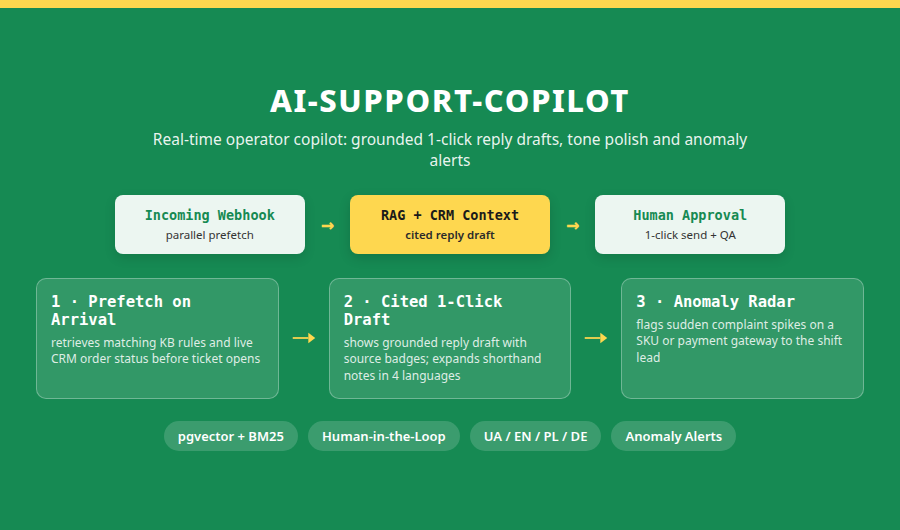
Overview
In complex B2B, medical, financial or high-ticket e-commerce support, letting a bot talk directly to customers is often unacceptable — yet human operators still spend 60% of their day searching internal docs, copy-pasting order details and rewriting the same explanations in different languages. ai-support-copilot sits quietly inside your operator’s chat panel or CRM: it reads the incoming message, fetches the customer’s live order state and matching knowledge-base articles, and prepares a grounded 1-click reply draft that the human reviews and sends.
Result: operators handle 2x more tickets per shift with consistent brand tone and zero policy mistakes, while every outgoing message remains 100% human-approved.
The Real Hard Part
An operator copilot only survives in production if it is faster and more accurate than typing by hand. If a suggested reply takes 12 seconds to appear or invents a return policy that doesn’t exist, operators simply ignore the panel. Every suggestion must be pre-computed on webhook arrival, strictly grounded in cited knowledge-base chunks and live CRM fields, and editable in one keystroke.
How It Works
- Pre-computation on message arrival. As soon as a customer message hits the webhook, the backend runs two parallel lookups before the operator even opens the ticket: vector + keyword search across your internal knowledge base (policies, specs, resolved tickets) and a live CRM lookup for the customer’s active orders or account state.
- Grounded reply draft with source citations. The copilot places a ready-to-send draft right above the reply box, alongside clickable badges pointing to the exact KB paragraphs and CRM fields used. If the KB has no answer, the copilot explicitly says “No matching policy found” instead of guessing.
- One-click tone polish and translation. An operator can type a rough 5-word shorthand note (e.g. “tell him warranty covers motor, send to branch 14, we pay shipping”) and expand it into a polite, brand-compliant reply in Ukrainian, English, Polish or German in 1 second.
- Live anomaly and spike detector. A background stream aggregator watches incoming ticket topics across the whole shift. When the same failure pattern spikes (e.g. 6 complaints about a broken payment method or a specific SKU batch within 20 minutes), it alerts the team lead in Telegram/Slack before a flood builds up.
Key Decisions
| Decision | Why |
|---|---|
| Human-in-the-loop by design | Zero risk of public AI hallucinations: the customer only ever sees what the operator approves and sends. |
| Parallel RAG + CRM prefetch on webhook | Generating the draft while the ticket sits in the queue means the suggestion is already waiting (0 ms perceived latency) when the operator clicks the chat. |
| Inline citation pills on every draft | Operators trust a draft only when they can verify the source rule or order status in one glance. |
| Sliding-window topic clustering for anomalies | Individual operators only see their own chats; a lightweight sliding-window counter over classified intents catches systemic outages or bad product batches within minutes. |
What You Get
- Operator copilot integrated into your Helpdesk, CRM or custom support workspace (browser extension, iframe sidebar or native webhook panel)
- Hybrid RAG search (pgvector + BM25) over your docs, SOPs and historical best replies
- Shorthand-to-reply expander, grammar/tone corrector and multi-language translator (UA/EN/PL/DE)
- Real-time anomaly alert channel for shift leads when specific complaint categories spike
Boundaries
- The copilot never sends messages autonomously unless you explicitly enable auto-reply for specific low-risk categories.
- Quality of policy drafts depends on maintaining an up-to-date source document or Notion/Google Docs/Confluence sync.
Stack
Go · Python · PostgreSQL (pgvector + FTS) · Redis Streams · OpenAI / Claude API · WebSockets / SSE · CRM & Helpdesk Webhooks