
feedsync — Supplier Feeds to Marketplace Price Lists
Overview
Independent project: a Go service that turns a supplier’s price feed (YML/XML, CSV or JSON) into Rozetka and Prom.ua price lists and keeps an OpenCart-style product table in sync. Category mapping, currency conversion, markup rules (fixed, percentage, by price range or category, with rounding) and stock filtering are configuration, not code; every rejected offer is reported with the rule it broke.
Result: 25,000 offers become both price lists in about 1.5 s using about 36 MB of memory, every published file passes an independent re-validation with 0 errors, and a repeat OpenCart sync changes nothing (≈25 ms).
The actual hard problem
Converting XML is easy. The hard part is that a marketplace rejects — or silently drops — a whole price list because of a few bad offers, and feeds are far too big to eyeball. So the pipeline is built around never publishing an unchecked file: the feed is streamed token by token, each offer is validated on its own, the finished file is re-read from disk and checked again with the same rule set, and only then does it replace the live one.
Architecture
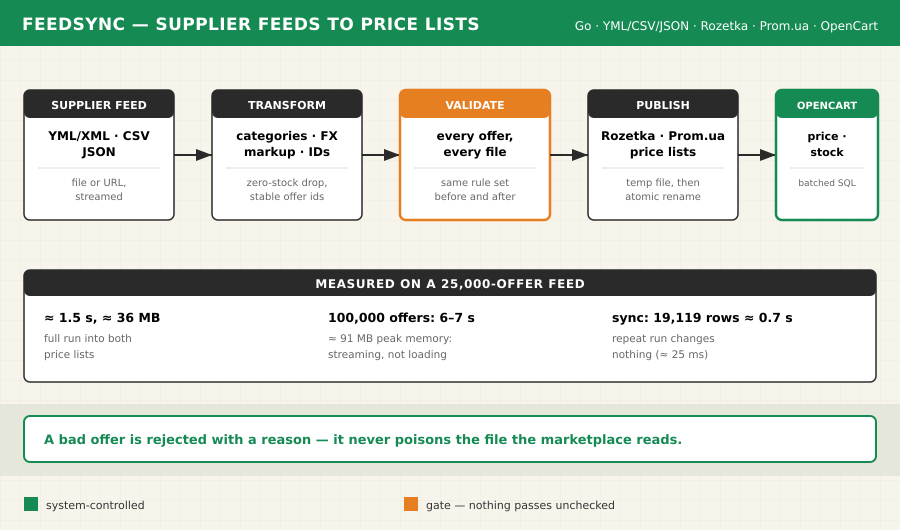
One streaming pass reads the feed, applies the transform, and writes each target to a temp file. Each target file is then re-validated from disk and atomically renamed over the published one; a failed run leaves the previous file in place. The same pass yields the OpenCart update list, applied as batched UPDATE … CASE statements in one transaction — only rows whose values actually differ are touched.
Key Engineering Decisions
| Decision | Why |
|---|---|
Streaming xml.Decoder, one DecodeElement per offer |
Memory does not grow with the feed: 4× the offers used ≈2.5× the peak memory (36 MB → 91 MB at 100,000 offers) |
| Post-validation re-reads the file and shares one rule set with pre-validation | The writer is not trusted to have written what it meant to; the published file is what gets checked |
| Atomic temp-file + rename publish | The marketplace never sees a half-written or failed file |
Deterministic offer IDs ([A-Za-z0-9]+ kept, otherwise prefix + SHA-1) |
The same supplier SKU gets the same ID on every run |
| Money as integer kopecks | No float drift in markup and rounding |
| Out-of-stock items are zeroed in the CMS with their price left alone | Dropping them from the price list is not enough — the shop would keep selling what the supplier no longer has |
Results
| Measure | Result |
|---|---|
| 25,000 offers (26 MB) → Rozetka + Prom.ua | ≈1.5 s, ≈36 MB peak memory |
| 100,000 offers (105 MB) | 6–7 s, ≈91 MB |
| Published files re-validated | 0 errors on both targets |
| Rejected for Rozetka | 259 offers, each with its rule (missing picture, non-HTTPS picture, missing vendor) in report.json |
| OpenCart sync, MySQL 8.4 | 19,119 rows in 39 batches, ≈0.7 s; repeat run: 0 updated, ≈25 ms |
Unit and integration tests run under -race.
Connecting it to your shop
- Supplier feed: set
source.pathto the supplier’s file or URL and picksource.format; a new format is one more reader. - Marketplaces: each entry under
targetswrites one price list — pointoutat the directory your web server exposes. - CMS: put the MySQL connection string in
opencart.dsnand price/stock sync starts with the next run. - Schedule:
feedsync convert -c config.yaml -every 30m.
Source: github.com/valpere/feedsync
Stack
Go · encoding/xml streaming · MySQL · SQLite · Docker