
fleet-crm — Fleet/Logistics CRM Backend
Overview
Independent demo project: a Go REST API for a fleet-dispatch CRM — clients, vehicles, drivers, a work-order lifecycle, invoicing, and a telematics webhook for ingesting live GPS/odometer pings from external hardware.
Built to demonstrate a pattern that keeps recurring in freelance requests — a dispatch company needing a CRM that ties clients, fleet, and billing together, fed by an external telematics/GPS provider — with the same engineering discipline as client-delivered work: interface-based repositories, a state machine instead of a free-form status column, and every claim below verified against a live binary, not just unit tests.
Result: full CRUD + auth + a checked work-order state machine + a webhook, with one real cross-entity bug found and fixed before the first commit.
Architecture
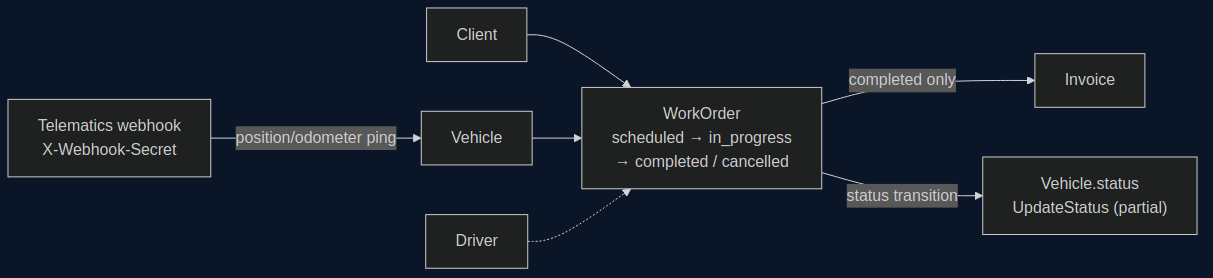
A WorkOrder ties Client + Vehicle (+ optional Driver) together and drives two things: an Invoice, only once completed, and the vehicle’s own status — set through a dedicated partial update, not a full-row replace (see below for why that distinction matters). A telematics webhook is the only unauthenticated write path into the API — gated by a shared secret, not a JWT, since it’s machine-to-machine.
Key Engineering Decisions
| Decision | Why |
|---|---|
| Work-order transitions checked against a single legal-edges table | scheduled → in_progress/cancelled, in_progress → completed/cancelled, both terminal states closed. A naive status column would let a request skip straight to completed or “un-complete” a finished job — illegal moves return 409 with a typed ErrIllegalTransition. |
Vehicle status changed via UpdateStatus (partial), never Update (full-row) |
Every Repository is an interface Service/Handler code depends on — swappable for an in-memory fake in tests, no database needed to run go test ./.... |
Invoice creation checks the work order is StatusCompleted first |
Billing before the job is actually done is a real-world bug class, not a hypothetical — enforced in the service layer, not left to the client to get right. |
Telematics webhook uses crypto/subtle.ConstantTimeCompare, not == |
A plain string comparison on a secret header leaks timing information proportional to the matching prefix length — small detail, but the kind that separates “read a tutorial” from “actually thought about it.” |
| No migration framework for 6 tables | Hand-rolled embedded-SQL runner (internal/db) — an applied_migrations table plus sorted embed.FS execution. Simpler than pulling in a dependency for a schema this size. |
The bug that mattered: an early version of the work-order → vehicle side effect called the general vehicle.Update(id, vehicle.Vehicle{Status: newStatus}) — passing a struct with only Status set. Since Update replaces the whole row, every single work-order status change would have silently zeroed the vehicle’s plate number, type, and odometer reading. Caught by a regression test asserting those fields survive a transition, and confirmed again in a live docker compose run before the first commit — not just trusted because the test passed.
Results
- Full REST API: JWT auth (bcrypt + 8h tokens, no public registration), CRUD for clients/vehicles/drivers, work-order lifecycle, invoicing, telematics webhook
- One real cross-entity bug found and fixed pre-commit — the
Update-vs-UpdateStatusdata-loss bug above - Interface-based repositories throughout — every service/handler test runs against in-memory fakes;
go test ./... -racepasses clean, no database required - Verified end-to-end, not just unit-tested:
docker compose up→ migrations apply on boot → seeded admin login → full CRUD → illegal transition rejected (409) → legal transition confirmed, including that untouched vehicle fields survive it → invoice-before-completion rejected (409) → invoice succeeds post-completion → both webhook paths (wrong secret rejected, correct secret updates the vehicle) confirmed against the live binary
Code: github.com/valpere/fleet-crm
Stack
Go · chi (router) · pgx/v5 (no ORM) · golang-jwt · bcrypt · PostgreSQL · Docker Compose · testify