
Gym Operations Platform — Shift & Task Management with AI Photo Validation
Overview
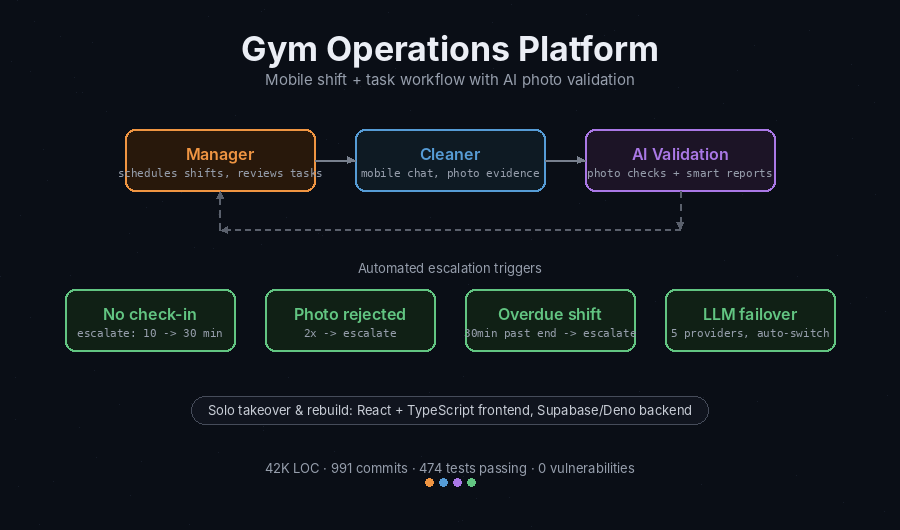
A shift-and-task operations platform for gym-cleaning teams. Managers schedule shifts across multiple brands and locations and review task photos; cleaners run their shift through a mobile-first, chat-style interface, submitting photo evidence for every task. AI validates the photos, flags anomalies, and generates shift summaries for managers.
Role: Freelance full-stack engineer / AI integration Timeline: 3 months, solo Domain: Field-services operations SaaS
The platform started life as a no-code MVP. I took over an existing, partially-built codebase and substantially rebuilt it into a production-grade system — 991 commits over three months, spanning the React/TypeScript frontend, the Supabase/Deno backend, and the AI integration layer end to end.
Solution
Two very different UX targets share one data model:
- Admin / Manager — desktop-first, sidebar navigation. Schedule shifts, review task photos, monitor live shift status across gyms and brands, read AI-generated reports.
- Cleaner — mobile-first, full-screen conversational workflow. Claim a shift, work through assigned tasks one at a time, submit a photo per task, get instant AI feedback.
Every task photo goes through automated AI validation before a manager ever sees it — catching obviously wrong or missing work early, so managers spend review time on judgment calls, not on screening.
Key Technical Decisions
Automated escalation, not manual monitoring
Three trigger types run continuously and notify managers the moment something needs attention, instead of relying on someone noticing a stalled shift:
| Trigger | Condition | Action |
|---|---|---|
| No check-in | 10 min → 30 min staged escalation | Cleaner nudged, then manager notified |
| Photo rejected | Same task rejected twice | Manager notified, shift flagged |
| Overdue shift | 30+ min past scheduled end | Manager notified, shift flagged |
Multi-provider LLM failover
Photo validation and report generation run through a primary/fallback LLM chain across five providers. If the primary provider degrades or rate-limits, the system fails over automatically — AI validation keeps working through provider outages instead of blocking the cleaner’s workflow.
Three-Layer data model
Facts → Computation → Interpretation, enforced at the schema level. Raw operational data (shifts, task submissions) is immutable once recorded; computed/derived state lives in its own layer; AI-generated interpretation (assessments, summaries) is append-only and never overwrites the facts it was derived from. Row-level security gates every table on this model, scoped to brand and role.
AI-agent development workflow
Given the scope of the rebuild (270+ files, no existing test baseline to lean on), development ran through a structured multi-agent pipeline rather than ad hoc prompting: a planning pass produces a spec, a tech-lead pass turns it into an implementation plan, generation and simplification passes produce and clean up the code, and independent code-review, security-review, and test-generation passes run before anything merges. This kept a solo, fast-moving rebuild from accumulating the kind of undocumented tribal knowledge that a from-scratch AI-assisted rewrite usually produces.
Results
| Metric | Value |
|---|---|
| Codebase size | ~42K lines across 270+ files |
| Commits (this engagement) | 991 over 3 months |
| Tests | 474 passing, 52 test files |
| Test-to-source ratio | 30% |
npm audit vulnerabilities |
0 |
| Escalation trigger types | 3, fully automated |
| LLM providers (failover chain) | 5 |
Stack
| Layer | Technology |
|---|---|
| Frontend | React 19, TypeScript 5, Vite, Tailwind CSS |
| Backend | Supabase (PostgreSQL, Auth, Row-Level Security) |
| Edge functions | Deno |
| AI / LLM | Multi-provider failover chain (5 providers) |
| Monitoring | Sentry |
| Testing | Vitest (unit), Playwright (E2E) |
| CI/CD | GitHub Actions |
| Infra | VPS + Nginx + Let’s Encrypt |