Overview
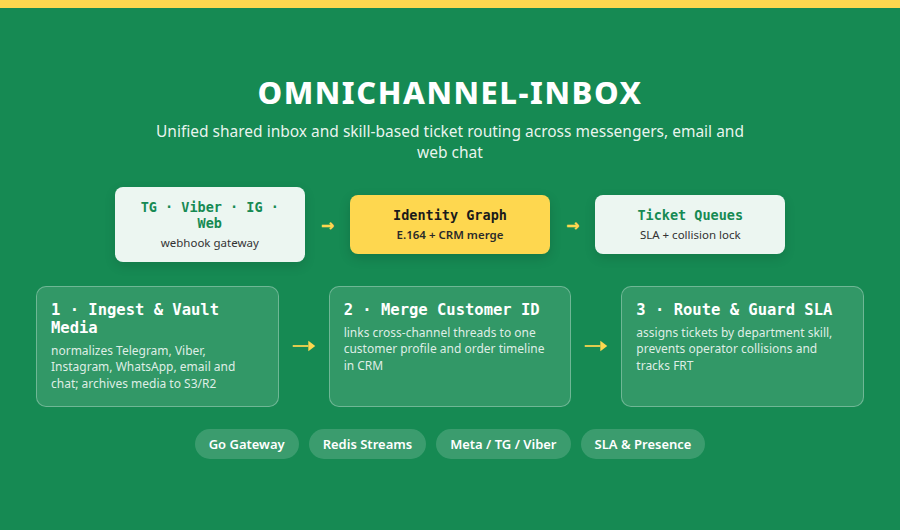
When customer messages arrive across five separate tabs — Telegram, Viber, Instagram Direct, WhatsApp, email and website live chat — leads get lost between shifts, two managers reply to the same buyer on different channels, and nobody knows the true first-response time. omnichannel-inbox consolidates every messaging channel and telephony webhook into a single shared inbox and structured ticket pipeline, linking every conversation to one unified customer profile in your CRM.
Result: zero lost messages across channels, a single timeline per customer regardless of where they write, and automatic ticket routing to the right specialist with SLA tracking.
The Real Hard Part
Every messaging platform has its own webhook quirks, media expiration rules, rate limits and 24-hour messaging windows (Meta / WhatsApp Business API). Worse, the same customer might ask a pre-sale question on Instagram, place the order on the website, and message on Viber about delivery. A reliable shared inbox has to normalize message schemas, re-host ephemeral media attachments, deduplicate customer identities across channels, and prevent two operators from colliding on the same ticket.
How It Works
- Unified webhook ingestion & media vault. A Go gateway receives webhooks from Telegram (Bot API / Business), Viber, Meta (Instagram Direct & Facebook Messenger), WhatsApp Cloud API, IMAP/SMTP email and your website chat widget. Voice notes, photos and PDFs are immediately downloaded and stored in S3/R2 so expiring platform links never break ticket history.
- Cross-channel identity resolution. Incoming contacts are matched against existing profiles by normalized phone number (E.164), email, order number or platform handle. When a buyer switches from web chat to Telegram, the operator sees both threads linked to the same CRM customer and order history.
- Intent classification & skill-based ticket routing. Each new conversation is tagged by topic (New Order, Delivery/TTN, Warranty/Return, Billing, B2B) and language, then routed to the responsible department queue with round-robin or load-balanced assignment among online operators.
- Collision lock, SLA timers & CRM sync. Presence indicators show when an operator is viewing or typing in a ticket. If a ticket approaches its SLA response limit (e.g. 5 minutes for hot leads), it escalates to the shift queue and logs response-time metrics to PostgreSQL and your CRM.
Key Decisions
| Decision | Why |
|---|---|
| Normalized internal event bus (Redis Streams / PostgreSQL) | Decouples unreliable external messenger APIs from your operator UI: outbound replies queue safely and retry with backoff if a messenger endpoint hiccups. |
| E.164 phone + order-ID identity graph | Solves the “split personality” problem where CRM shows three separate leads for one customer writing from Viber, Instagram and email. |
| Optimistic ticket locking & live presence | Stops two operators from typing conflicting answers to the same client at the same time. |
| First-class Meta 24h window tracking | Automatically tracks WhatsApp / Instagram messaging window expiry and switches to approved template messages when a 24h session closes. |
What You Get
- Unified shared inbox connecting Telegram, Viber, Instagram Direct, WhatsApp, Email, Web Chat and IP telephony events
- Cross-channel customer deduplication and two-way sync with your CRM (KeyCRM, SalesDrive, KeepinCRM, HubSpot or custom workspace)
- Skill-based ticket queues, collision prevention and SLA breach alerts
- Real-time support analytics: First Response Time (FRT), resolution time, channel volume and operator load
Boundaries
- Official WhatsApp Business API and Instagram Direct integrations require a verified Meta Business account.
- Can be deployed either on top of an open-source workspace (e.g. Chatwoot / custom web UI) or bridged directly into your existing CRM/Telegram Topics workflow.
Stack
Go · PostgreSQL · Redis Streams · WebSockets · S3 / Cloudflare R2 · Telegram / Viber / Meta Graph / WhatsApp Cloud APIs · Chatwoot / Custom Web Inbox · CRM Webhooks