
Sales CRM Platform — Conversation-First CRM with AI Reporting & Decision Billing
Overview
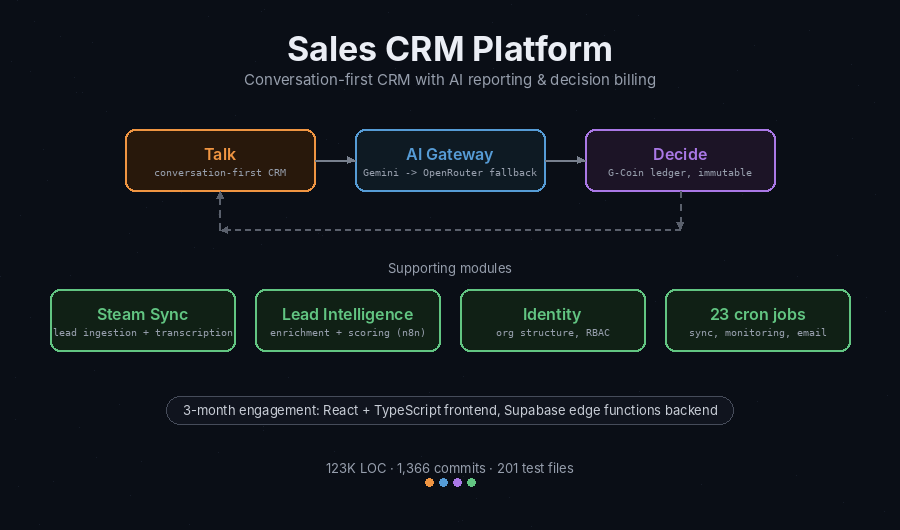
A modular sales-CRM platform built around conversations rather than static records. A conversation workspace (chat-first, dual-layer status system) sits at the center; AI-powered reporting, lead enrichment, and organizational-intelligence modules build on top of it, all governed by a deterministic, immutable billing ledger for AI-assisted actions.
Role: Freelance full-stack engineer / AI integration Timeline: 3 months Domain: Sales CRM / lead management SaaS
Joined an in-flight rebuild and became the primary contributor over the engagement — 1,366 of the repository’s 2,888 commits, spanning frontend, backend, and the AI integration layer.
Solution
The platform is organized into independently-versioned modules that share one data model:
- Talk — conversation-first CRM workspace with a dual-layer status system and multiple AI assistance modes
- See — AI-generated visual reports and financial risk modeling (“living reports” that update as underlying data changes)
- Decide — decision-impact tracking and a token-based billing ledger for AI-assisted actions
- Identity — organizational structure: roles, positions, computed team intelligence
- Tenancy — authentication, data isolation, and privilege-based access control
- Steam Sync — lead ingestion from an external telephony/CRM system, including call transcription and agent assignment
- Lead Intelligence — automated lead enrichment and scoring via an external workflow-automation layer
Key Technical Decisions
AI gateway with provider fallback, not hardcoded calls
Every AI code path routes through a single gateway function rather than calling a provider SDK directly. System prompts live in a database table (5-minute TTL cache) so prompt changes don’t require a deploy. The gateway calls a primary provider and automatically falls back to a secondary on rate-limiting or provider-side errors — AI-dependent features (analysis, translation, summarization, scoring) keep working through a provider outage instead of failing the whole pipeline.
Deterministic, immutable billing ledger
AI-assisted actions consume a token-based currency, and every consumption event is written to an append-only ledger — no action ever mutates or overwrites a prior entry. Billing state is always reconstructible by replaying the ledger, which matters both for auditability and for debugging “why does this account show this balance” days after the fact.
Cron-driven background processing, not request-time work
23 production cron jobs handle sync, monitoring, and email processing outside the request/response cycle — lead synchronization, result-code auto-sync, scheduled reference-data refreshes, queued email delivery. Keeping this work off the request path keeps the conversation workspace responsive regardless of how much background synchronization is happening.
Trunk-based deployment across two environments
Both staging and production deploy from the same branch (trunk-based since mid-engagement), rather than maintaining a long-lived staging branch that drifts from what’s actually shipping. Reduced the class of bugs that only show up because staging and production were quietly running different code.
Results
| Metric | Value |
|---|---|
| Codebase size | ~123K lines (frontend + edge functions) |
| Commits (this engagement) | 1,366 out of 2,888 total |
| Test files | 201 |
| Production cron jobs | 23 |
| Independently-versioned modules | 7 |
| AI providers (gateway fallback) | 2 (primary + fallback), plus a separate enrichment/scoring stack |
Stack
| Layer | Technology |
|---|---|
| Frontend | React 19, TypeScript, Vite, Tailwind CSS |
| State / data | TanStack React Query v5, React Router v7 |
| Backend | Supabase (PostgreSQL, RLS, Edge Functions) |
| AI / LLM | Google Gemini (primary), OpenRouter (fallback), separate enrichment/scoring providers |
| Automation | n8n (lead enrichment workflows) |
| Infra | VPS + Nginx + Let’s Encrypt, trunk-based deploy to staging + production |