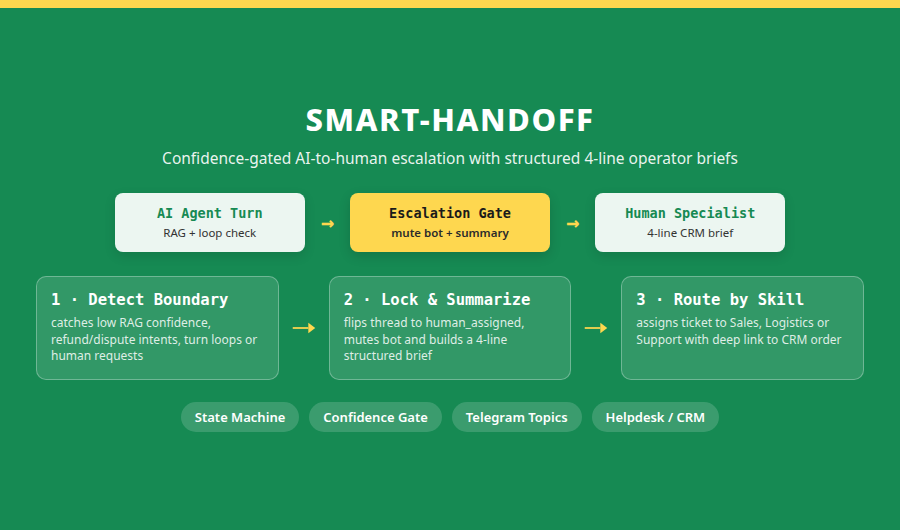
Overview
The quickest way an AI support bot destroys customer trust is by refusing to let go: repeating “I didn’t quite catch that” when the user has a non-standard problem, or dumping the chat onto a human agent who then asks the customer to explain everything all over again. smart-handoff is an escalation and context-packaging layer between your AI agent and your human support team that detects when the bot should step back and hands the operator a clean, structured brief in seconds.
Result: AI handles the 70–80% of routine requests it actually knows, and the remaining 20–30% reach the right human specialist on the first transfer with zero customer repetition.
The Real Hard Part
Knowing when to escalate is harder than answering a FAQ. If the threshold is too loose, the bot hallucinates answers on edge cases (damaged parcels, custom B2B quotes, billing disputes); if too hair-trigger, 60% of simple chats flood human operators. Worse, dumping a 30-message raw transcript onto a busy operator slows them down instead of helping. Escalation has to combine deterministic tripwires (high-risk intents, repeated turn loops, explicit human requests) with a compact structured handoff packet.
How It Works
- Multi-signal escalation gate. Every conversation turn is evaluated against four conditions:
- Low grounding confidence: RAG retrieval score falls below threshold or the question is outside the knowledge base.
- High-stakes intent: refund claims, payment failures, legal/complaint keywords, or B2B custom pricing.
- Loop & sentiment detector: 2+ clarification attempts on the same step, negative sentiment spike, or an explicit “operator / human” request.
- Tool failure: an underlying CRM or stock API returns an error or ambiguous match.
- State lock and bot mute. The moment any tripwire fires, the state machine flips the thread from
bot_activetohuman_assigned, muting automated replies so the bot never talks over the operator. - Structured 4-line operator brief. Before notifying the team, a fast summarization pass extracts a strict JSON brief attached to the top of the ticket:
- Customer & Order: verified name, phone/handle, linked CRM order ID and status.
- Core Issue: one-sentence statement of what the customer wants.
- Already Checked: what the bot already verified (e.g. “TTN 204509… shows arrived at branch #12; customer says box is damaged”).
- Why Escalated: trigger reason (
refund_request,low_kb_confidence,user_requested_human).
- Skill-based routing and return to AI. The thread is routed to the matching operator group (Sales, Logistics, Billing, Tech Support) in Telegram, Slack or your Helpdesk/CRM. Once the operator resolves the edge case, they can flip the thread back to
bot_activewith one command.
Key Decisions
| Decision | Why |
|---|---|
| Deterministic tripwires alongside confidence scores | LLM self-reported confidence is poorly calibrated on its own. Combining retrieval similarity scores, turn-loop counters and hard intent rules makes escalation predictable and auditable. |
Instant bot mute on handoff (human_assigned lock) |
Prevents the classic embarrassment where a human operator replies and the bot fires an automated message two seconds later. |
| 4-line structured brief instead of raw chat walls | An operator joining a live chat needs the order link, what was already tried and the exact blocker in 5 seconds — not 40 lines of bot greetings. |
| Working-hours & fallback handling | If escalation happens at 02:00 AM outside shift hours, the system sets honest expectations, collects the exact artifacts needed (e.g. photo of the damaged item) and pins the ready ticket to the morning queue. |
What You Get
- Confidence, loop and risk-intent escalation gate integrated into your existing bot or web chat
- Automatic state locking (
bot_active↔human_assigned) with operator return controls - Compact 4-line context brief with direct CRM/order deep links on every escalated ticket
- Routing by department, shift schedule and SLA priority (Telegram topics, Helpdesk, CRM)
Boundaries
- Does not replace human judgment on disputed refunds or policy exceptions — its job is to bring the right human in at the exact right moment with full context.
Stack
Go · Python · Redis (session state machine) · PostgreSQL · OpenAI / Claude Structured Outputs · Telegram Bot API (Forum Topics) · Webhooks / Helpdesk / CRM APIs