
subgate — Telegram Paid-Channel-Access Backend
Overview
A Go REST API for Telegram paid-channel access — subscribers, gated channels, idempotent payment-webhook ingestion, and a membership state machine (active → grace → expired). Models the pattern behind paid-access Telegram bots: a payment gateway calls back on success, and the backend has to turn that callback into “grant/extend channel access” exactly once, even when the gateway retries and a scheduled expiry check fires at the same moment.
Result: exactly-once payment processing under both a redelivered webhook and a concurrent expiry sweep — the real failure modes of gateway callbacks and cron-driven downgrades, not hypothetical ones — proven live against 10 concurrent identical webhook deliveries and 5 concurrent renewals racing 5 concurrent sweeps.
The actual hard problem
Payment gateways redeliver “payment succeeded” notifications — a timeout on the gateway’s side after the server already processed and 200’d the first delivery triggers a retry. Naive handling extends a subscription, or grants channel access, once per delivery instead of once per payment. Separately, a scheduled expiry sweep and a just-landed renewal can race for the same membership: the sweep must never downgrade access that was correctly renewed moments earlier.
Architecture
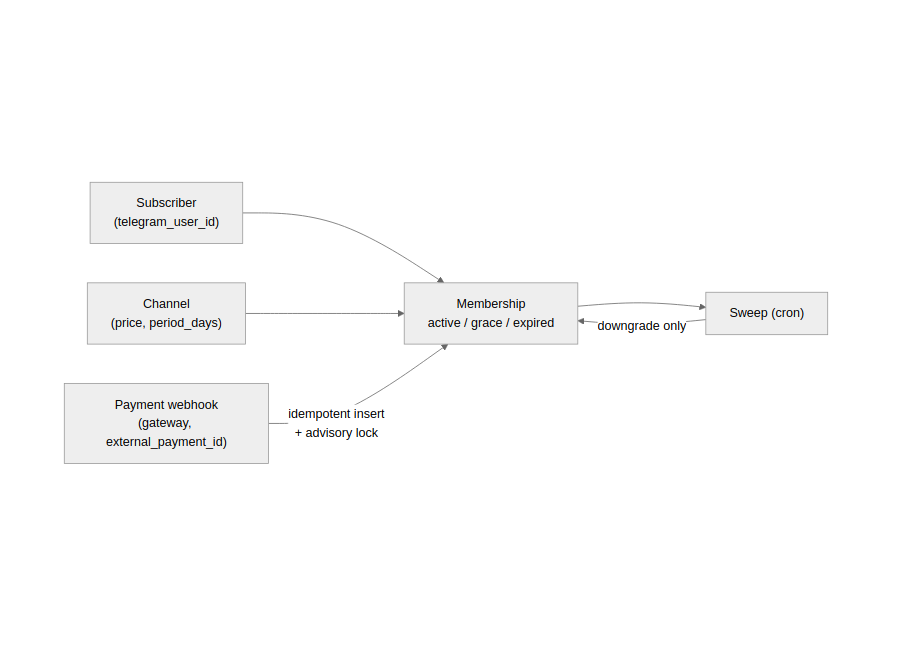
Every webhook delivery runs through one transaction: acquire the (subscriber_id, channel_id) advisory lock → insert-or-ignore the payment → look up the channel’s billing period → upsert the membership, extending expires_at from whichever is later, its current value or the payment date → commit. The expiry sweep takes the same lock per membership before re-reading and downgrading, which is what actually closes the race against a renewal in flight.
Key Engineering Decisions
| Decision | Why |
|---|---|
payments.UNIQUE(gateway, external_payment_id) + ON CONFLICT DO NOTHING |
A redelivered webhook is absorbed at the database level — no duplicate payment row, no double-extended subscription |
pg_advisory_xact_lock(subscriber_id, channel_id) — Postgres’s native two-key overload, not a hashed single key |
Every payment-renewal and every sweep decision for the same membership is serialized; a sweep that reaches a membership mid-renewal blocks on the lock and re-reads fresh state once it acquires it, instead of racing a stale read |
NextSweepStatus extracted as a pure function of current status, expires_at, now, and grace days |
No I/O, fully unit tested — active→grace→expired only ever moves forward; a payment is the only thing that resets it to active, and expired is a documented terminal state the sweep can never resurrect from |
| Sweep exposed as an authenticated endpoint, not wired to an actual cron | Keeps the demo self-contained — the downgrade behavior is triggered and verified without a scheduler dependency, same reasoning as exposing a webhook endpoint instead of requiring a real payment gateway account |
| Webhook signed per-payload (HMAC-SHA256 over the order reference + amount + timestamp), not a static shared-secret header | Mirrors how a real gateway (WayForPay, chosen over Stripe — it shows up roughly 3x more often across the demand data this project is grounded in) actually signs callbacks, and means a tampered amount invalidates the signature |
Results
- Full REST API: JWT auth, subscriber/channel/membership CRUD, a signed
POST /api/webhook/payment(machine-to-machine, not a staff action) - The downgrade decision is pure and fully unit tested — including the terminal-state and zero-grace-period edge cases — with no database required to run
go test ./... - Verified end-to-end via
docker compose up: migrations apply, seeded login, a full payment → active membership → backdated-expiry → sweep-to-grace sequence behaves as documented - 10 concurrent deliveries of the identical webhook payload produced exactly 1 payment row and exactly 1 membership extension — 1 response with
duplicate:false, 9 withduplicate:true - 5 concurrent renewal webhooks racing 5 concurrent expiry sweeps against the same already-past-due membership landed deterministically
active, withexpires_atcorrectly extended — never left stuck ingraceorexpiredby a sweep that raced ahead of the renewal
Code: github.com/valpere/subgate
Stack
Go · chi (router) · pgx/v5 (no ORM) · golang-jwt · bcrypt · PostgreSQL (pg_advisory_xact_lock, make_interval) · Docker Compose · testify