
session-indexer — Per-Project Semantic Session Recall for Claude Code
Links:

Per-project semantic search over Claude Code session history. Indexes JSONL transcripts into a local SQLite store; retrieves via bge-m3 embeddings (Ollama) with FTS5 BM25 fallback. Automatically injects relevant past context at session start — no centralized server, no shared state between projects.
The Problem
Returning to a project after a week and needing to find “what did we decide about X” across dozens of past Claude Code sessions is a real friction point. A simple rolling log gives you “where I left off last time” — useful, but it doesn’t answer “what have we discussed about this topic, ever?”
Why not a centralized memory tool? Tools like mempalace and agentmemory maintain a single shared store across every project and agent. That architecture has one fatal flaw: if the central store dies, everything dies. A corrupt index or a crashed MCP server takes down memory for all your projects simultaneously, and recovery is non-trivial.
session-indexer is per-project and append-only — .claude/sessions.db
lives inside the project’s own .claude/ directory. The worst failure mode
is losing one project’s DB, which is fully recoverable by re-running mine
on the available JSONL transcripts (idempotent by design). Every project is
isolated; nothing you do in one can break another.
How It Works
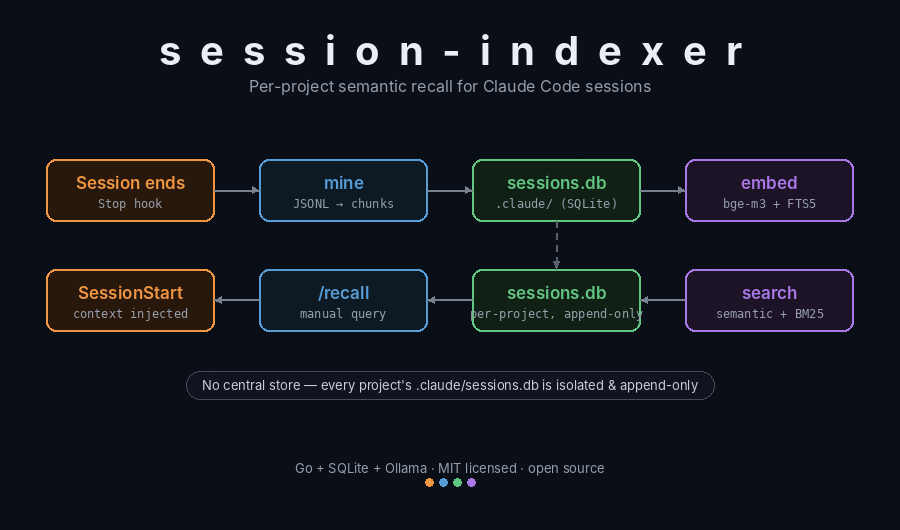
Two Claude Code hooks wire the system in:
- Stop hook (
session-index.sh) — mines the just-finished session’s JSONL transcript into.claude/sessions.db, embedding each chunk via bge-m3 if Ollama is available. - SessionStart hook (
session-recall.sh) — derives a search query from the current git branch name and recent commit messages, searches the index, and injects the top matching chunks as session context — automatically, with no manual query needed.
Manual search is also available at any time:
session-indexer search "config validation approach" --db .claude/sessions.db
# or from inside Claude Code:
/recall config validation approach
CLI
session-indexer mine   <jsonl-path> --db .claude/sessions.db
session-indexer search <query>      --db .claude/sessions.db [--limit N] [--json]
session-indexer embed               --db .claude/sessions.db
session-indexer stats               --db .claude/sessions.db
mine runs with a 50-second deadline (headroom under the 60s Stop-hook
budget) — storing is fast and unconditional, embedding respects the
deadline. Chunks past the deadline are stored but flagged for backfill via
embed, so nothing is ever silently dropped.
Search quality
When Ollama + bge-m3 are available, search ranks by cosine similarity over 1024-dim multilingual embeddings (English + Ukrainian both score well). When Ollama is unavailable or the store has zero embeddings, search falls back to FTS5 BM25 keyword matching automatically — no configuration needed, no hard dependency on any external service.
Tech Stack
- Go 1.26 — single static binary, no runtime dependencies
- SQLite (
modernc.org/sqlite, pure Go, no cgo) — per-project storage - Ollama + bge-m3 — optional vector embeddings for semantic search
- Cobra — CLI framework
- FTS5 — automatic keyword-search fallback
Why This Matters
Most AI coding assistants either forget everything between sessions or bolt
on a centralized memory service that becomes a single point of failure
across your entire workflow. session-indexer takes the opposite approach:
boring, per-project, append-only SQLite — the same architectural instinct
that makes Git itself reliable. If it breaks, it breaks alone, and it heals
itself by re-mining the transcripts that are already sitting on disk.
Open source, Apache 2.0 licensed, built to be forked and adapted.