
Tumanomir — Measuring the Fog Before AI Agents Turn It Into Architecture
Links:
Туманомір — a Go CLI that digitizes the “fog” of specifications before you let AI agents turn that fog into architecture. It’s the reference implementation of the Source of the Unknown methodology: specs consumed by AI agents are not sources of truth but distributions over possible implementations, so the tool measures the spread instead of assuming it away.
The Problem
Handing a spec to an AI coding agent and getting back five subtly different implementations is a familiar experience, but “subtly different” has no number attached to it. Tumanomir gives it one: how traceable are the requirements, how dense are the machine-readable constraints, and how far apart do independent generations from the same spec actually land.
Metrics
| Metric | Layer | What it measures |
|---|---|---|
K_drift |
deterministic | requirements without [REQ-*] -> [FUN-*] trace edges (trace-markup coverage, not implementation correctness) |
D_const |
deterministic | lexical density of machine-readable constraints (advisory-only, never blocks the gate) |
D_pair |
stochastic (LLM) | 1 − mean pairwise AST similarity of N generations |
H_norm |
stochastic (LLM) | cluster entropy / log₂N — ordinal signal only |
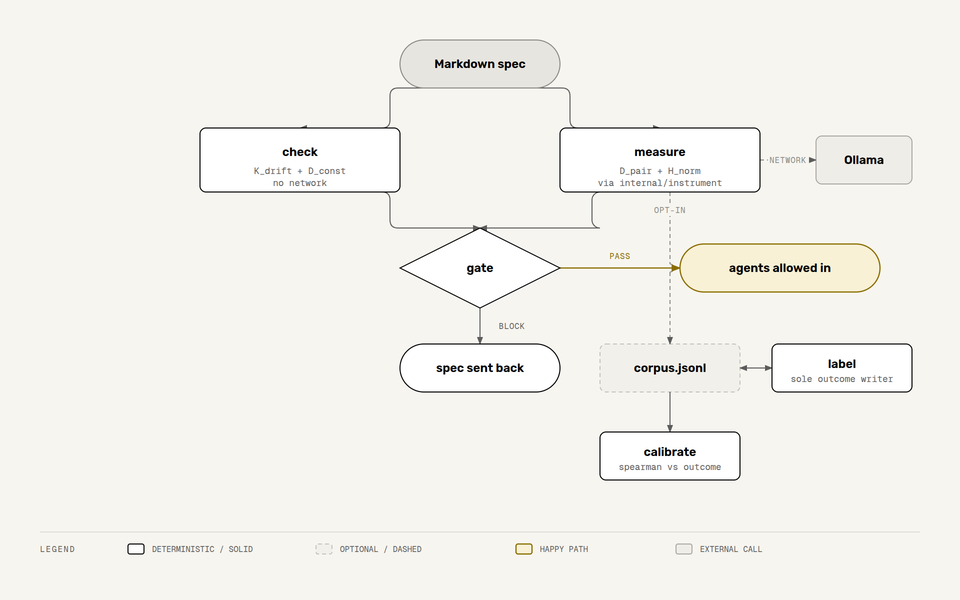
The deterministic layer needs no LLM and runs as a git hook, instantly. The stochastic layer generates N Go artifacts from the spec via a fixed instrument (Ollama) and measures how far apart they land — the wider the spread, the foggier the spec.
CLI
tumanomir check docs/                 # deterministic, instant, no network
tumanomir measure spec.md --instrument ollama:qwen3-coder:30b -n 10 \
  --temp 1.0 --sim-threshold 0.95 --num-ctx 8192 --num-predict 2048
tumanomir gate spec.md --instrument ollama:qwen3-coder:30b -n 3 \
  --num-ctx 8192 --num-predict 2048   # both layers, for CI
tumanomir calibrate corpus.jsonl      # Spearman correlation vs. a labeled corpus
tumanomir label <hash-or-prefix> <score>  # the sole writer of a corpus outcome
check runs deterministically and instantly. measure/gate require an
explicit --instrument (backend:model) and --num-ctx/--num-predict —
gate refuses to silently downgrade to deterministic-only if a
temperature is passed but no instrument resolves, since a silent
degradation would be a measurement-integrity bug, not a convenience.
--format json on check/measure/gate gives a single compact JSON
object for CI parsing.
Sample deterministic run, from Tumanomir dogfooding its own spec:
$ tumanomir check docs/requirements.md
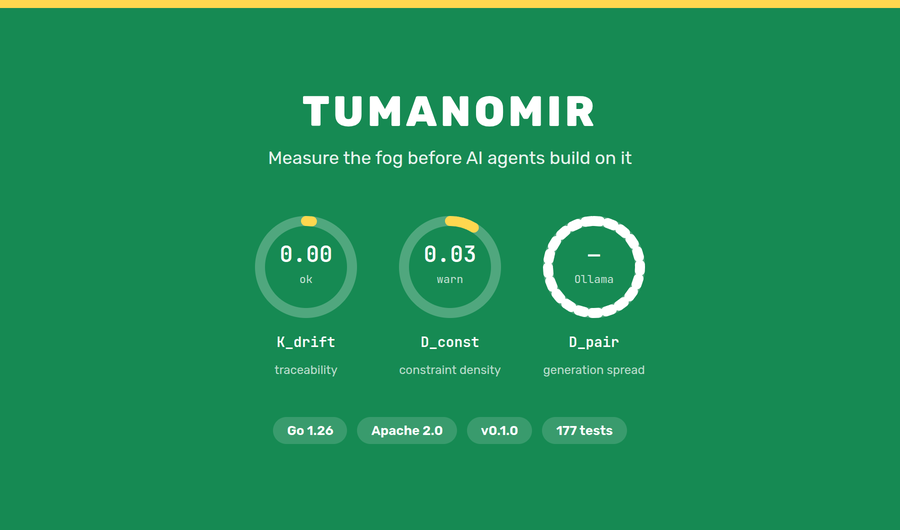
  K_drift:  0.00  [ok]     (threshold 0.20, 0/33 requirements untraced)
  D_const:  0.03  [warn]   (threshold 0.35, 101 markers / 3905 prose tokens)
  D_pair:   —     (stochastic layer: run `tumanomir measure` with an instrument)
All stochastic measurements are instrument-relative: results are reported together with the full instrument configuration and are not comparable across models without recalibration.
Architecture That Earns Trust, Not Just Correctness
The deterministic packages (internal/metrics, internal/spec,
internal/config, internal/calibrate) are barred from touching the
network — not as a convention, but as a test (TestNoNetworkImports)
that fails CI if a net/* import ever creeps in. That’s what makes
check and calibrate safe to run as a git hook or in air-gapped CI.
D_const is architecturally incapable of blocking the gate
(REQ-CHK-06) — it’s fixed in code as a tested invariant, not left as a
caveat in documentation that could be forgotten under deadline pressure:
it’s a lexical proxy, not ground truth on specification precision.
The $K_{drift}$ scanner was rewritten from regexp to a hand-written
byte scanner (PR #68), cutting allocations from scaling with requirement
count to a flat 14 allocs/op — a full check on a 1MB spec completes in
16.7ms, well within a 100ms budget.
Tech Stack
- Go 1.26 — single binary, one external dependency (
gopkg.in/yaml.v3) - Ollama — pluggable instrument backend for the stochastic layer
- Cobra-style CLI,
.tumanomir.yamlfor optional config defaults
Status
v0.1: check, measure, gate, calibrate, and label are all
implemented and work end-to-end — 66 commits, 64 merged PRs, zero
reverts over 25 days of development. No tags exist yet; the version is
honestly marked -dev, not claimed as a release.
What’s still open, by the project’s own account: no real labeled
corpus exists yet for calibrate to correlate against, so the default
thresholds (0.20 / 0.35 / 0.30) remain hypotheses, not calibrated
numbers. D_pair is instrument-relative — the same spec, same
instrument, and three consecutive runs produced verdicts ranging from
“ok” to “block”. A single instrument (Ollama, qwen3-coder:30b) has
been tested; OpenAI/Anthropic backends aren’t built. Only one projection
(Go type definitions) is implemented, so v0.1 is Go-specific. The full
deep-dive article walks through the
evidence, the benchmarks, and an honest “ladder of claims” table
separating what’s proven from what’s still a hypothesis.
Open source, Apache 2.0 licensed.