
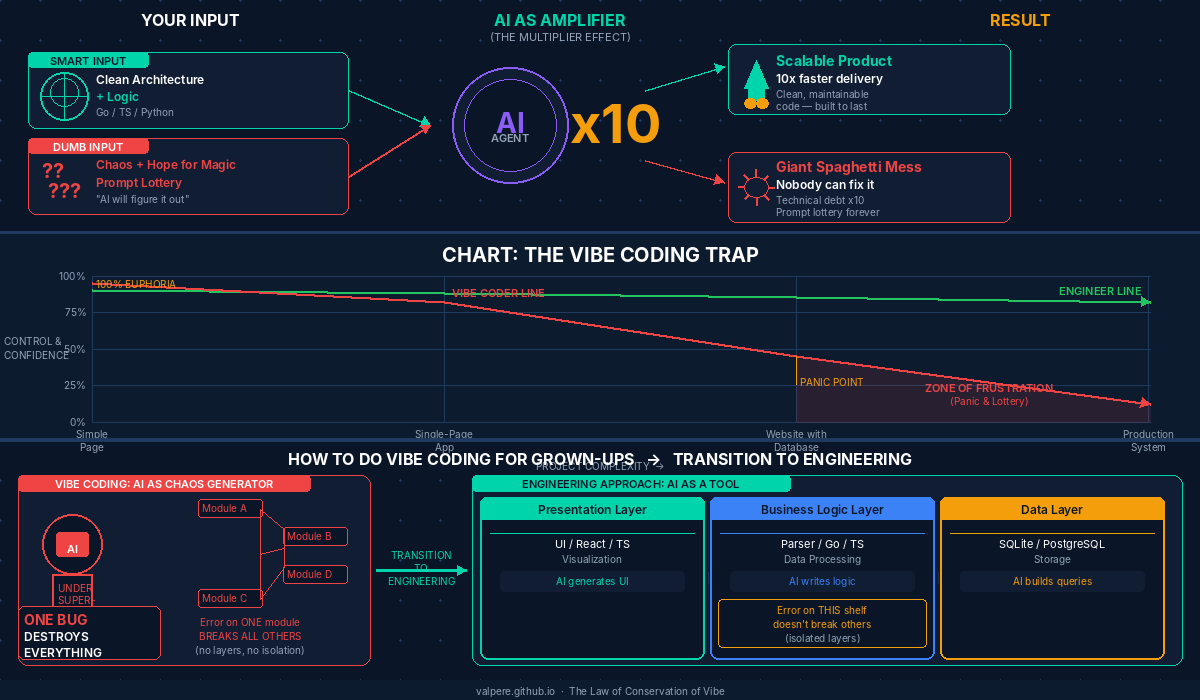
Anyone who has ever tried writing code with modern AI agents like Claude Code or Cursor knows that feeling of pure euphoria. You type a prompt in plain English, hit Enter, and watch hundreds of lines of working code materialize right before your eyes. Buttons click, databases sync, the app runs. You feel like a tech deity, and traditional learning feels like a relic of the past. Welcome to the era of “vibe coding.”
But give it a day, a week, or a month, and the magic evaporates. You ask the AI to add one tiny feature, and everything shatters. You ask it to fix the error, it politely replies, I apologize for the mistake..., rewrites half the project, and breaks three more things in the process. Euphoria instantly morphs into panic and helplessness.
Why does this happen? There is no witchcraft here. In reality, vibe coding obeys the fundamental laws of human psychology and logic.
1. The Anatomy of Frustration: Why We Fear the Unknown
Human psychology is wired quite simply: we fear what we do not understand. The less real knowledge you have about the processes happening under the hood, the more anxiety, distrust, and frustration bubble up when things go sideways.
The current hype machine sells a beautiful fairy tale: “You don’t need to learn anything, just twist the prompts.” It’s an easy narrative to buy into. But by avoiding foundational learning, people unconsciously trap themselves in a state of perpetual stress. When you pilot development completely blind, every line of AI-generated code becomes a black box. You have no idea if it’s secure, whether it will crash the server under load, or how to scale it later.
The takeaway is simple: Learning is still worth it. Not to memorize programming syntax by heart, but to eliminate the fear of the unknown and regain absolute control over your own product.
2. The Fine Line Between Mastery and Luck
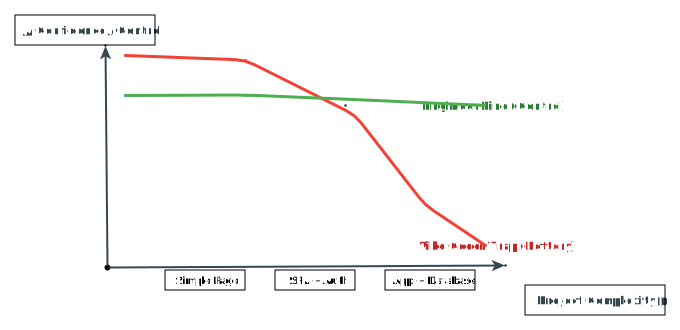
In any craft, things go smoothly as long as your knowledge and skills match the complexity of the task.
- As long as you know the traffic rules and how to balance, you ride a bicycle with confidence.
- As long as you understand the pattern and the stitches, you crochet a beautiful sweater.
- As long as you plant crops using a proven method, you get a predictable harvest.
But the moment your skill set falls short, control vanishes. You enter a zone of pure improvisation where the final outcome no longer depends on your mastery. Instead, it relies entirely on your raw wit and sheer luck.
In vibe coding, the line between mastery and luck is razor-thin. While the AI is generating simple, isolated snippets, you feel lucky. But as the system grows more complex, architectural flaws accumulate like a snowball. If you don’t know how to manage this process systematically, your startup or work project turns into a lottery. And you cannot build a business on luck.
3. The Golden Equation of AI: The Multiplier Effect
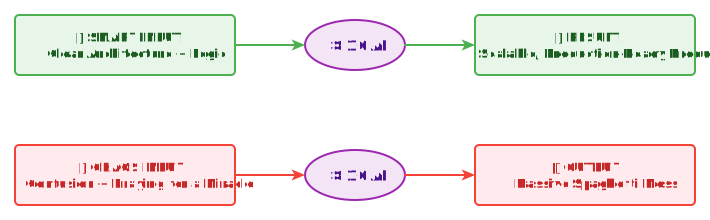
Remember the golden rule of working with Large Language Models: Sherlock Holmes does not live inside Claude or ChatGPT. AI is simply an amplifier of whatever is already inside your head.
It operates as a mirroring multiplier:
- Injected a smart, structured thought? If you understand architecture, data layers, and clean logic, the AI will amplify it tenfold. It will instantly handle the boilerplate, save you weeks of manual labor, and deliver an outstanding result.
- Injected chaos and confusion? If you are just hoping the AI will magically figure out the best approach on its own, brace yourself. The AI will amplify that chaos with the exact same blazing speed. You will instantly receive a massive, scalable mess that no human will ever be able to untangle.
As long as you clearly comprehend what you are doing, the AI “comprehends” where to go. The moment you start sinking and lose the thread of control, get ready—the AI will sink three times faster, validating your mistakes with the unearned confidence of a university professor.
Vibe Coding for Grown-Ups: Coming Back to Earth
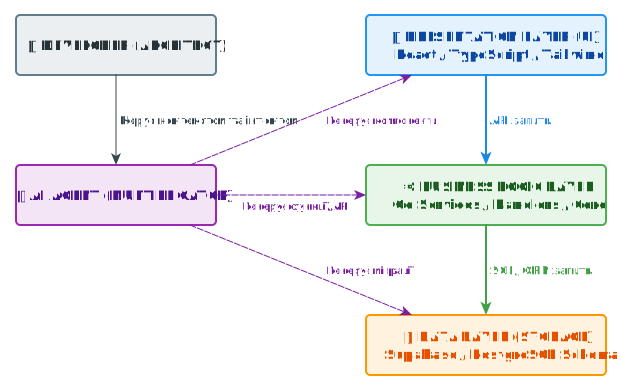
There is no magic. Modern neural networks are just incredibly powerful, high-tech shovels. But to build a sturdy house, it is not enough to just swing a shovel fast. You still need to be an architect.
I use AI agents in my daily development workflow, but I know exactly where the “vibe” ends and engineering begins. I don’t propose learning dry theory for the sake of theory, or memorizing decade-old textbooks. I propose learning how to be the conductor and architect for your AI assistants.
If you are tired of playing the prompt lottery, and want to finally understand how to design databases properly, manage model context windows, and build real, production-ready products — I can help you get there.
Three types of people typically come to this kind of learning:
- Vibe coders — already burned, but still believing in the magic. A good fit: small group online workshops where we dissect a real project, build a prompting system, and develop practical techniques for daily work.
- Non-IT professionals — marketers, managers, product people, business owners — who want to boost their results with AI without going deep into programming. Same group format, but focused on their specific tools and workflows.
- Those who want to grow seriously — individual mentoring and coaching: your project, your pace, targeted feedback.
In all three cases, learning is built around projects directly relevant to your field — not abstract exercises for the sake of it.
- Check out my real Projects to see the architectural approaches I put into practice.
- Read my Blog where I share hands-on engineering insights.
- Dive into my Portfolio to learn more about my tech stack and collaboration formats (ranging from one-on-one mentorship to practical workshops for teams).
Let’s transform your vibe coding from a random result generator into a predictable tool for building great products.
P.S. A Bonus for Those Who Made It This Far 🎁
Since you stuck around and agree that knowledge is the ultimate antidote to fear and bugs, here is a practical life hack.
AI doesn’t just have to generate gigabytes of code and amplify your chaos. It can also act as your personal, free, and infinitely patient mentor, helping you build your knowledge base effortlessly right while you work.
Here are three simple techniques to upgrade your engineering foundation without opening a single dry textbook:
- The “ELI5” Method (Explain Like I’m 5): If the AI spits out a piece of code containing an unfamiliar concept (like a specific middleware, database replication, or complex asynchronous patterns), don’t just copy-paste it blindly. Tell the model: “Explain the concept of [topic] to me like I’m 10 years old and obsessed with Lego. Use simple analogies.” Your brain will snap into the logic in 30 seconds.
- Reverse Engineering: Instead of saying “write code for X,” ask the AI to analyze an existing solution. Use this prompt: “Here is a working piece of code. Break it down into logical layers and explain why these specific architectural choices were made over alternative options.” This trains you to see systems, not just characters on a screen.
- Interactive Quiz Mode: Once you finish building a feature, challenge the model: “Ask me 3 tricky questions about the code we just wrote to test if I truly understand how it functions under the hood. Don’t reveal the answers upfront—let’s go one by one.”
This turns learning into a highly engaging game. You acquire knowledge at the exact moment you need it to solve a concrete problem. No rote memorization—just pure, contextual mastery.
Vibe responsibly, and see you over at my Homepage! 😉