
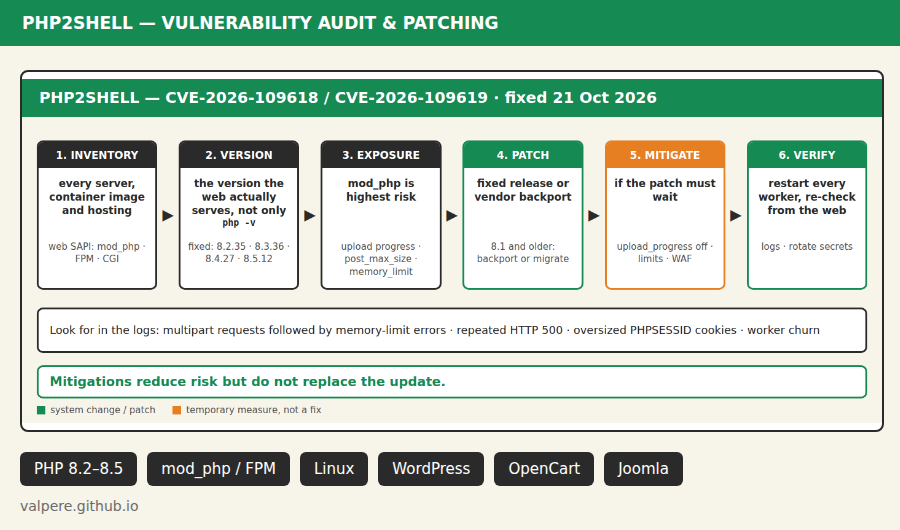
php-vulnerability-audit — PHP2Shell Audit, Patching and Hardening
Overview
On 21 October 2026 the PHP project shipped emergency releases for two critical remote-code-execution flaws in the interpreter itself, CVE-2026-109618 and CVE-2026-109619 (“PHP2Shell”, found by Wiz Research). The bug is not in a CMS or a plugin: any site running a vulnerable PHP is exposed, however clean its own code is, and PHP versions as old as 5.4 are affected.
This service finds where a vulnerable PHP is running in your infrastructure, brings it to a fixed version (or to a safe interim state), proves the fix from the web side, and checks whether the server was already hit. For WordPress, OpenCart, Joomla, Laravel and custom PHP sites, on a VPS, a dedicated server, shared hosting or in Docker.
Fixed versions
| PHP branch | Fixed version (21 Oct 2026) |
|---|---|
| 8.5 | 8.5.12 |
| 8.4 | 8.4.27 |
| 8.3 | 8.3.36 |
| 8.2 | 8.2.35 |
| 8.1 and older | No updates from the PHP project. Minimal source backports exist for 7.4, 8.0 and 8.1; some distributions and LTS vendors ship their own fix. Otherwise: migrate to a supported branch |
PHP’s own advisory is direct: there are no complete mitigations, updating is the only safe choice.
What is covered
| Step | What is done |
|---|---|
| Inventory | Every server, VPS, hosting account, Docker image and CI runner that serves PHP, and which web SAPI it uses (mod_php, PHP-FPM, CGI, LiteSpeed, FrankenPHP). The advisory rates mod_php highest, because an exploit can fire before any application code runs |
| Version check | The version the web actually serves, not only php -v in a shell: the CLI and the web SAPI are often different builds. Compared against the fixed versions above |
| Patch | The fixed release; or the vendor’s backport (Ubuntu, Debian, AlmaLinux, CloudLinux, cPanel, Plesk); or a migration to PHP 8.3 / 8.4 with a compatibility pass over the CMS, plugins and custom code on a staging copy first |
| Interim mitigation | Only when the patch cannot go out today, and only the measures from the PHP advisory: session.upload_progress.enabled=0 set in php.ini or the FPM pool (not via ini_set() or .user.ini), fatal_error_backtraces=0 on PHP 8.5, a low post_max_size, memory_limit set where applications cannot override it. Plus a WAF rule or an IP allow-list for a critical site. Documented as temporary |
| Verification | Every PHP worker restarted, the version re-checked from the web side, a smoke test of the site and its checkout or forms |
| Compromise review | Logs checked for the signs published by Wiz: multipart requests followed by memory-limit errors, repeated HTTP 500, unexpectedly large or malformed PHPSESSID cookies, PHP worker churn. File-integrity diff against clean CMS cores. If exposure is likely: database passwords, API keys, tokens and certificates rotated, because one of the flaws can disclose worker memory |
Application logs may show little, since the flaws sit below the application layer. A clean log is therefore not treated as proof of a clean server; the review is a set of checks, not a guarantee.
How it goes
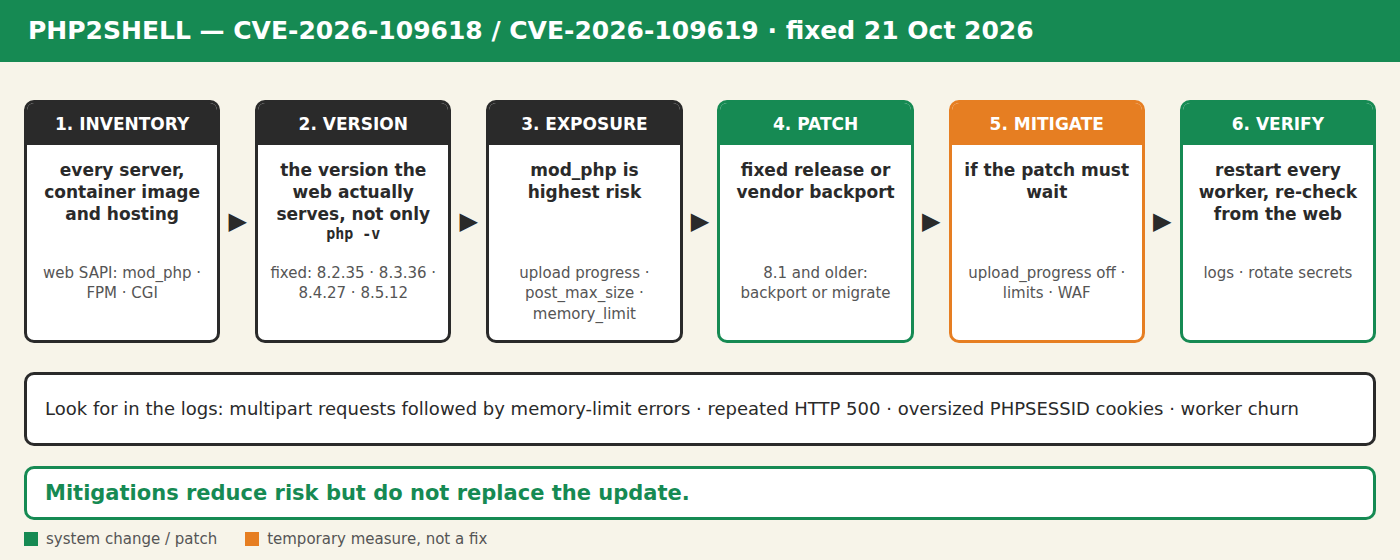
- Inventory and version check. A list of every host with the PHP version and SAPI it really serves.
- Risk and plan. Hosts ordered by exposure; for each, a route: update, vendor backport or migration.
- Patch on staging, then production. For stores and sites with custom code the update is rehearsed on a copy; the switch is done in a quiet window.
- Verification and review. Workers restarted, version re-checked from the web, logs reviewed, secrets rotated where needed.
- A short report. Hosts, versions before and after, what was changed, what remains (for example an end-of-life PHP that needs a planned migration).
If a site is already compromised, the cleanup follows site-security-cleanup; if the move to a new server or PHP version has to happen without downtime, see zero-downtime-migration.
Sources
Stack
PHP 5.4 – 8.5 · mod_php · PHP-FPM · Apache · Nginx · LiteSpeed · Linux (Ubuntu / Debian / AlmaLinux) · Docker · WordPress · OpenCart · Joomla · Laravel · Cloudflare WAF · ModSecurity · Fail2ban