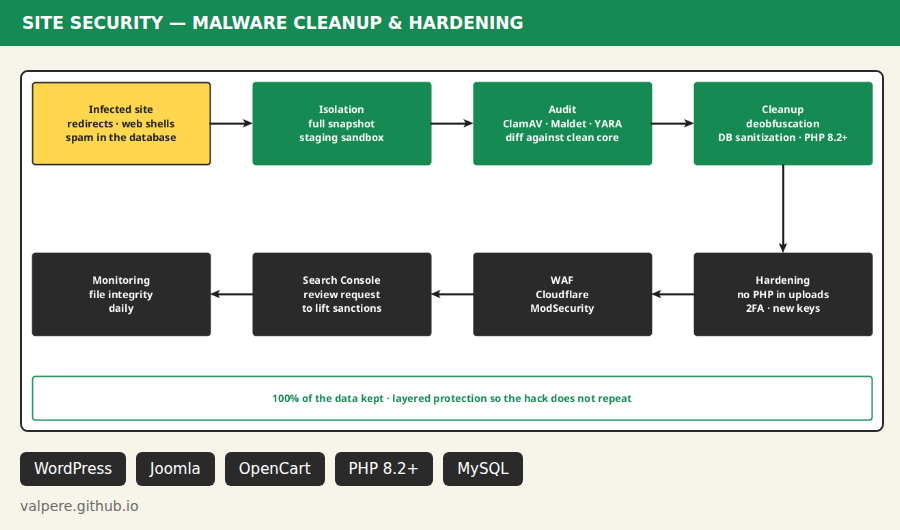
Overview
Full recovery of sites and online stores after a hack, a malware infection, hidden mobile redirects (to casino or pharma pages), spam injected into the database, or mass spam sent from the server. Built for WordPress, OpenCart and Joomla, with 100% data preservation. The aim is to isolate and cure the threat, lift the Google Safe Browsing (“red screen”) and hosting-provider blocks, move the site to a safe stack (PHP 8.2+), and put layered protection in place so it does not come back.
Threats and how they are handled
| Threat | How it is handled |
|---|---|
| Hidden, conditional redirects that fire only for mobile visitors or for traffic from Google or Bing, so the owner sees a normal site in the admin | Heuristic and signature scanning, plus a diff against clean CMS cores |
Web shells and layered backdoors in upload folders (/wp-content/uploads/, /image/catalog/, /images/), obfuscated PHP such as eval(base64_decode(...)) |
Search for eval, assert, gzinflate, str_rot13 and create_function; CMS core and third-party plugins replaced with originals verified by checksum |
SEO spam and database injection: thousands of junk pages in the Google index via wp_posts, oc_product_description or modified templates |
MySQL scanned for malicious JS, hidden iframes, unknown administrators and spam links, then sanitized |
| Blocks by the host or by search engines (“Deceptive site ahead”) | A review request in Google Search Console with a report of the work done |
How it goes
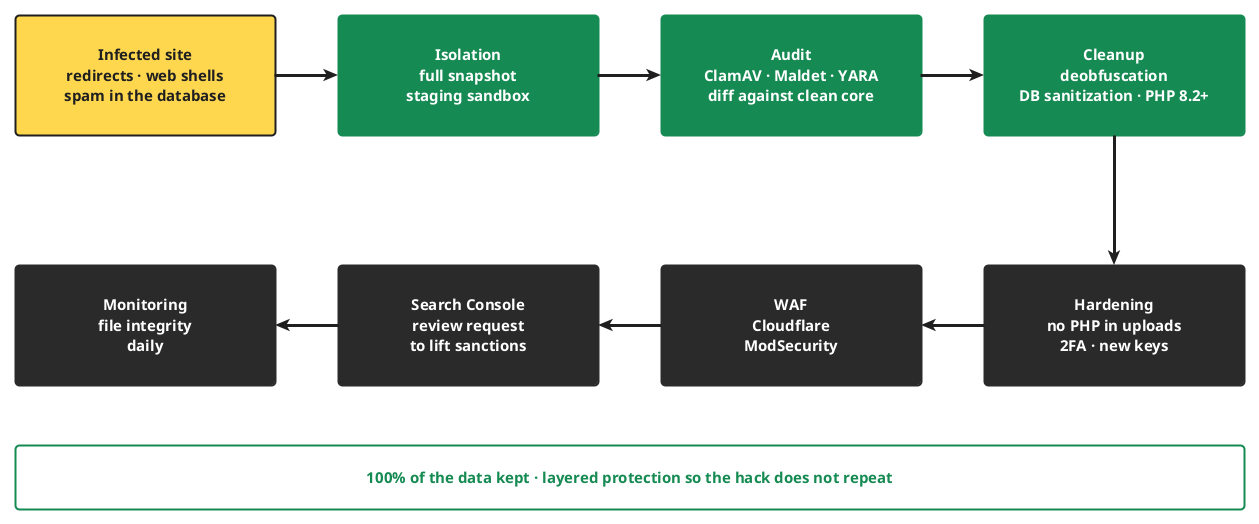
- Isolation, backup, sandbox. A full isolated archive of the infected site and the database dump, deployed to a closed test stand so visitors are not affected and the infection stops spreading.
- Deep scan and backdoor removal. File-system scanning with server tools (
maldet,clamav, custom regex rules), a replacement of the CMS core and plugins with verified originals, and an audit of active themes and custom modules for SQL injection, XSS and arbitrary file upload. - Database and config cleanup. MySQL checked for malicious JS inserts, hidden iframes, unknown administrators and spam links;
.htaccess,nginx.conf,wp-config.phpandindex.phpcleaned and protected. - Hardening and WAF. PHP, CGI and Python scripts blocked in media upload directories (
/uploads/,/cache/,/tmp/); access closed to configuration files and backups (.sql,.tar.gz,.env,.git); all passwords (database, FTP, SSH, admin) and authentication keys rotated; Cloudflare WAF cutting off botnets, login brute-force and scans for known vulnerabilities. - Review and monitoring. A review request to Google Search Console with a report, and daily file-integrity monitoring.
Related: zero-downtime-migration.
Stack
WordPress · OpenCart 2.x / 3.x · Joomla 3 / 4 / 5 · MODX · Laravel · PHP 8.1 / 8.2+ · MySQL / MariaDB · Linux (Ubuntu / Debian) · Nginx · Apache · Linux Malware Detect · ClamAV · WP-CLI · ModSecurity · Cloudflare WAF · Fail2ban · Google Search Console