
Tumanomir — CLI for Measuring AI-Spec Ambiguity
Overview
Independent R&D project: a Go CLI that turns “the spec is unclear” from a vague complaint into three measurable metrics an AI coding agent’s context can be gated on before it writes a line of code.
The methodology was published first — Source of the Unknown proposed $K_{drift}$ (untraced requirements), $D_{const}$ (constraint density), and $D_{pair}$ (generation spread across N samples) as a way to price ambiguity like an engineering tolerance, not a feeling. Tumanomir is the reference implementation: 25 days, 66 commits, zero reverts, gating its own specification in CI from day one.
Result: a working check/measure/gate/calibrate/label pipeline, with every claim in the follow-up article backed by a real, reproducible CLI run — not a retelling.
What Shipped
$ tumanomir check docs/requirements.md
  K_drift:  0.00  [ok]     (threshold 0.20, 0/33 requirements untraced)
  D_const:  0.03  [warn]   (threshold 0.35, 101 markers / 3905 prose tokens)
  D_pair:   —     (stochastic layer: run `tumanomir measure` with an instrument)
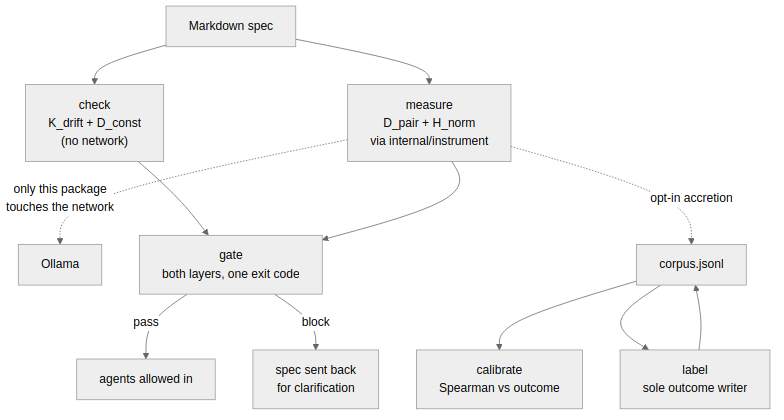
Five commands, each demonstrated against the tool’s own live spec:
check— deterministic layer, no network, ~17ms on 1MBmeasure— stochastic layer against a real Ollama instrument (N generations, structural AST diff)gate— both layers combined for CI, refuses to silently degrade when--tempis passed without a resolved instrumentcalibrate— Spearman correlation of metric values against outcome labels, from a corpus, never re-measuredlabel— the single command allowed to write a corpus row’s outcome
Architecture
spec.md ──► check (K_drift, D_const)  ─┐
        └─► measure (D_pair, instrument) ─┴─► gate ──► exit 0/1 (CI)
                                                │
corpus.jsonl ──► calibrate (Spearman) ◄────────┘
The deterministic packages (internal/metrics, internal/spec, internal/config, internal/calibrate) have no right to touch the network — enforced by a test that parses their transitive dependencies and fails if net/* shows up, not by a comment someone can forget under deadline pressure.
Key Engineering Decisions
| Decision | Why |
|---|---|
Hand-written byte scanner over regexp for $K_{drift}$ |
3260 → 14 allocations/op, independent of requirement count — full check on 1MB fits in 16.7ms |
$D_{const}$ architecturally cannot block the gate (VerdictBlock) |
It’s a lexical proxy, not ground truth — advisory-only by design, fixed as a tested invariant, not a caveat |
PromptV1 as a named, versioned Go constant |
Reproducibility — the generation prompt is never an inline literal that can silently drift |
Spearman, not Pearson, in calibrate |
outcome is an arbitrary caller-defined scale; only the monotonic relationship is meaningful |
| No embedding-based synonym matching for naming noise | Explicitly rejected — it would reintroduce model non-determinism into a metric whose whole value is being a fixed, reproducible instrument |
The finding that mattered most: a test isolating naming noise from structural divergence showed identifier choice alone can produce $D_{pair} = 0.6667$ on a fixed structure — two-thirds of the similarity signal near the blocking threshold can be how a model names a variable, not how it understood the spec. Recorded as a measured, open Phase-2 question rather than smoothed over.
Results
- 66 commits, 64 merged PRs, zero reverts over 25 days
- v0.1.0-dev, feature-complete — 5 commands working end-to-end, no external dependency besides
gopkg.in/yaml.v3 make dogfoodgates the tool’s own spec in CI on every change- 233× fewer allocations in the $K_{drift}$ scanner after a targeted rewrite (PR #68)
- Every CLI output quoted in the published follow-up article was re-run against the live binary before publishing — not transcribed from memory
Code: github.com/valpere/tumanomir · Write-up: Source of the Unknown → Tumanomir
Stack
Go · Ollama (qwen3-coder:30b instrument) · AST-based structural diff · Spearman correlation · YAML config · GitHub Actions CI