
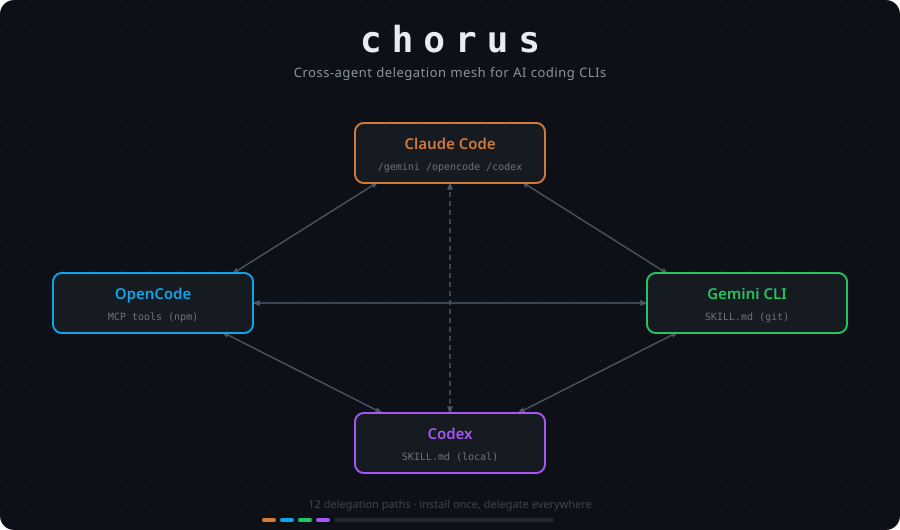
Most AI coding tools are designed like islands.
You pick one — Claude Code, OpenCode, Gemini CLI, Codex, Cursor, or Kilo — and stay inside its workflow. A second opinion means copying context, switching terminals, re-explaining the task, waiting, comparing answers, and manually carrying the result back.
I built chorus to remove that step.
What it does
chorus is an open-source plugin collection that creates a full 6×6 delegation mesh between six AI coding CLIs:
| From \ To | Claude | OpenCode | Gemini | Codex | Cursor | Kilo |
|---|---|---|---|---|---|---|
| Claude Code | — | ✅ | ✅ | ✅ | ✅ | ✅ |
| OpenCode | ✅ | — | ✅ | ✅ | ✅ | ✅ |
| Gemini CLI | ✅ | ✅ | — | ✅ | ✅ | ✅ |
| Codex | ✅ | ✅ | ✅ | — | ✅ | ✅ |
| Cursor | ✅ | ✅ | ✅ | ✅ | — | ✅ |
| Kilo | ✅ | ✅ | ✅ | ✅ | ✅ | — |
Each agent can delegate tasks to the other five, without leaving its own interface.
How it integrates
Claude Code gets slash commands:
/opencode:run refactor the auth module
/gemini:review check this diff for edge cases
/codex:run write tests for the new retry logic
/cursor:run check if this fits existing codebase patterns
/kilo:run review for naming clarity and maintainability
OpenCode gets MCP tools:
delegate_claude("review this migration for data loss risk")
delegate_gemini("analyze this for performance bottlenecks")
delegate_codex("add integration tests")
delegate_cursor("check pattern consistency across the repo")
delegate_kilo("review for long-term readability")
Gemini CLI, Codex, Cursor, and Kilo get skills/rules — install once, then delegate in natural language.
The workflow that actually matters
Parallel code review. Ask five different agents to review the same diff independently, each with a different focus:
/gemini:review   — correctness and edge cases
/codex:run       — test coverage and missing cases
/cursor:run      — codebase integration and pattern consistency
/kilo:run        — maintainability and naming clarity
/claude:review   — security and correctness
Different models have genuinely different failure modes. One may miss an edge case another catches. One may overweight architecture where another spots a missing test. You read all five and make the call. The agents provide the raw material; judgment stays with you.
OpenCode participates in the full 6×6 mesh but is excluded from parallel workflow patterns — its TUI stdout isn’t capturable programmatically.
Named workflow commands
Instead of wiring five separate commands with different prompts each time, chorus ships named workflow patterns as first-class installable plugins:
| Command | What it does |
|---|---|
/chorus:review |
Parallel review of git diff HEAD — one command, 5 independent opinions |
/chorus:council |
Same task to all 5 agents with different roles; host synthesizes |
/chorus:debug |
Ranked root-cause hypotheses from 5 agents for a bug symptom |
/chorus:second-opinion |
Quick independent check from one chosen agent |
OpenCode gets these as MCP tools: council, parallel_review, parallel_debug, second_opinion. Gemini CLI, Codex, Cursor, and Kilo get them as skills/rules.
Install
# Claude Code
claude plugin install https://github.com/valpere/chorus

# OpenCode
opencode plugin @valpere/chorus-opencode

# Gemini CLI
gemini skills install https://github.com/valpere/chorus --path for-gemini/claude
# ... and other agents
Full installation for Codex, Cursor, and Kilo is in the README.
chorus is not trying to be a new IDE or orchestration platform. It is plumbing between tools developers already use. One install, six agents, zero new workflows forced on you.